Basic Fundamentals of Chemistry
You may have come across the definition of chemistry numerous times in middle school or high school. However, it can also be defined in a more musical fashion. Imagine a piano with many keys resembling different atoms or substances; chemistry is the sound these notes make and how they are played together to create unique chords and captivating melodies. A reaction such as a neutralization shows how acids and bases interact with each other to create new substances, which is the equivalent to a prelude with chords resolving into a more melodic verse. Even the scales on a piano can be the equivalent of a period on the Periodic Table. Chemistry is seen everywhere, whether you are a scientist working in a lab or simply cooking food for your friends and family.
Chemistry has been around since the days of ancient civilization (more commonly known as alchemy) and began to pick up traction during the 17th and 18th centuries. Alchemy had dealt with more of the transmutation of matter, commonly trying to convert ordinary base metals into precious ones. Alchemy was believed to originate from Egypt and Arabia, the root Arabian saying “al-kimia” literally refers to preparation of the Stone or Elixir. This holds true as one of the primary, superficial goals of alchemy was to seek an all-curing ‘Elixir of Life’ or more commonly known as ‘philosopher’s stone.’
Although numerous observations were based on scientific fact, alchemy would prove these phenomena using superstitious ideas, making this topic more of a ‘proto-science.’ The first man to combat this misunderstanding of science was Anglo-irish chemist Robert Boyle. His book ‘The Skeptical Chymist’ published in the late 17th century was the first initiative towards disapproving and rejecting alchemic beliefs. One major idea he disapproved of was that all matter was made up of the four elements; earth, water, fire, and air. Following breakthroughs in the 17th and 18th centuries, such as the discovery of new gases (hydrogen by English physicist Henry Cavendich, and nitrogen by Daniel Rutherford who also developed the nuclear model of an atom), metallurgy, and the introduction of the scientific method and quantitative experimentation by French chemist Antoine-Laurent de Lavoisier, had allowed modern chemistry to flourish.
Russian chemist Dmitri Mendeleev was one of the pillars that formed one of the most crucial aspects of chemistry: the famed ‘Periodic Table of Elements.’ By 1869, 63 elements had been discovered, and Mendeleev took on the task of arranging these elements in a table. These 63 elements were organized into rows based on their atomic number and into columns based on their chemical and physical attributes. There are now 118 known elements known to man as of now.
Ingredients of our Universe
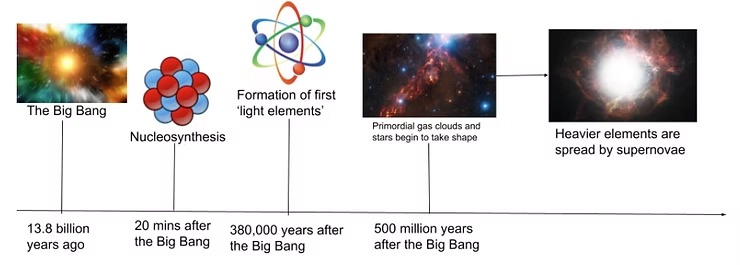
It is estimated that close to 13.8 billion years ago, a balloon-like phenomenon occurred. At the time, our universe was no more than the size of a subatomic particle, and everything was condensed into that minuscule point. The Big Bang then commenced, where this minute point exploded, releasing unimaginable amounts of energy as it began expanding quite rapidly. As time passed, space had a chance to cool down and initiate the formation of neutrons, protons, electrons, positrons, photons, and neutrinos.
Nucleosynthesis had then taken place approximately less than 20 minutes after the occurrence of the Big Bang. This process allowed for the first-ever atomic nuclei to come into being; however, it would take many more years for electrons to be trapped in orbits around these synthesized nuclei. Roughly 380,000 years had passed since the Big Bang when the universe continued to expand and then began to cool, allowing electrons to surround the already-formed nuclei to birth the first ‘light elements’. These elements included; deuterium (a stable isotope of hydrogen), helium, and lithium, with hydrogen and helium being the most abundant elements following the events of the Big Bang. Both are still the most abundant elements to date, making up 75% and 25% of visible matter in the universe, respectively.
500 million years after the Big Bang, the primordial gas clouds or nebulae that had formed would condense to allow the first stars to take shape. Stars burn due to the release of energy from nuclear fusion of hydrogen atoms, that’s why our Sun gives light and heat. One hydrogen atom fuses with another and another to not only release energy, but also form elements like helium and lithium.
At the end of the star’s life, they go into an explosive state called ‘Supernova’ Supernovae typically possess elements heavier than Iron (atomic mass 56) due to the constant fusion of hydrogen. Due to the immense shockwave of the supernova, it allows the distribution of ‘heavy elements’ throughout the galaxy. They would take on the task of creating new heavier elements and distribute them throughout the universe to create new molecules and substances, some of which turned out to be the building blocks of life. These ‘heavy elements’ are the ones we frequently see and have become quite common nowadays.
The Purpose of Astronomy
Astronomy is a branch of science that involves the study of celestial bodies and phenomena that occur in the cosmos. The core aim of astronomy has been to make sense of the Universe. Astronomers that belonged to the ancient era of humanity were baffled about phenomena that had occurred against the night sky. Even questions that seem extremely simple, such as why planets move, the mysterious appearances of comets, and the apparent remoteness of the Sun and other stars, have been asked. However, it is these questions that have intrigued certain people and made them want to find suitable answers. Today, the scope of astronomy has indeed shifted drastically to questions that are more complex, yet the curiosity and endeavor of humans to find answers prevail to this day.
It is difficult to pin down exactly where the concept of astronomy may have originated. Furthermore, archeology even goes on to say that many ancient societies had considered astronomical phenomena to be a cultural resource. We can only speculate on the knowledge ancient scientists possessed so far. The oldest written record of astronomy that we have today dates back all the way to the time of the Mesopotamians (around 1600 BCE). It is believed that the concept of “zodiacal signs” originated from the Babylonians. They were the first to make a lunisolar calendar with 12 lunar months. These 12 segments were based on certain star positions (constellations) which we commonly refer to as “zodiac signs”. Another unique use of star positions was when ancient Polynesian voyagers would use these positions to track their location and guide themselves. Ancient records prove to be useful in understanding the way scientists of that time brainstorm ideas. However, since mythology had been quite significant, most observations were given superstitious attributes.
One of the most crucial milestones was the proposal of heliocentrism (Sun positioned at the center). In 1543 Polish polymath Nicolas Copernicus stood up to combat the idea that “The Earth was at the center of the universe” (geocentrism) proposed by Aristotle in the 3rd Century BC, which was greatly approved by Catholic beliefs. Despite Copernicus’ hypothesis being correct, he unfortunately died long before he could justify it and had many inaccuracies in his heliocentric model. The next step towards establishing the idea of heliocentrism presented itself in 1608 when the Dutch invented an integral instrument. It was none other than the ‘Telescope’. This piqued the interest of a certain Italian polymath who proved Copernicus’ theory by making his own telescope. The man who took on the challenge to defy Catholic beliefs was none other than Galileo Galilei.
However, until the 19th century, astronomers were only capable of tracking the movement of celestial bodies. Even French philosopher Auguste Comte commented in 1842 that it wouldn’t be possible to understand the compositions of planets. However, as science progressed further, new methods using spectrum light analysis began to unveil the possibility of understanding the physical nature of cosmic entities. It later became known as ‘Astrophysics’. A groundbreaking discovery in 1929 would prove the Milky Way is not the sole galaxy in the cosmos. American astronomer Edwin Hubble proved the existence of other galaxies along with the fact that the universe is constantly expanding. This is how he proved the existence of our neighboring Andromeda Galaxy and now have a clear picture of it thanks to the Hubble Telescope.
How does chemistry go hand in hand with, which is known as a spectrum, to identify or observe astronomy?
Astronomy as a whole is a broad discipline that has quite a number of subfields, which include observational astronomy, theoretical astronomy, cosmology, astrophysics and more. Amongst these subfields is one where chemistry and astronomy intersect, called ‘Astrochemistry.’ Astrochemistry is the study of the chemical composition of molecules and the abundance of reactions that occur in an extraterrestrial environment. Most experimentation is usually done under controlled laboratory conditions; however, since the cosmos is so vast and wide, the entire Universe as a whole is a grand laboratory.
This field is still relatively new, as it only began in the 1930s with the help of American physicist Karl Guthe Jansky. In 1932, he was able to detect radio emissions coming from the center of the Milky Way. Near the end of WWII, Dutch astronomer H. C. van de Hulst would prove the existence of hydrogen gas in the Milky Way. He theoretically predicted that hydrogen in space should absorb and emit spectral lines (radio waves) at a wavelength of 21 cm. His prediction was proven true in 1951 by American physicists Harold Ewen and Edward Mills Purcell. This was the first step towards astrochemistry as it would later be known as ‘Radio Astronomy’. Radio waves are one method for astronomers to figure out the composition, structure and motion of objects in space.
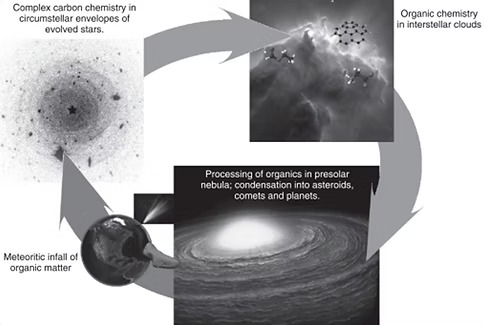
Along with the discovery of hydrogen, the next step of ‘radio astronomy’ was to find and prove the existence of organic molecules. Between the 1930s-1940s, several optical astronomers took the initiative to discover simple interstellar molecules. These molecules include CH, CH+, and CN, which would indicate the presence of molecules in interstellar medium that allow the formation of such. It has been proven that carbonic and organic molecules follow a certain pathway to be distributed throughout our universe. The last decade has seen the emergence of two powerful ‘Radio Telescopes’. Namely the ALMA and the NOEMA telescopes that have contributed to proving the existence of more than 120 interstellar molecules.
Present-day relevance of Astrochemistry
In the modern day, the composition of cosmic objects is analyzed using a method called ‘Spectroscopy’. It involves the dispersion of light (specifically electromagnetic radiation) into constituent wavelengths which is known as a spectrum, for identifying or observing how a chemical substance interacts. Each element or compound has its own distinct spectrum, making it possible to identify the composition of different cosmic objects. A common way we can observe spectroscopy is the classic flame test. Each metal produces a unique color when it burns with oxygen, such as potassium producing a lilac flame, strontium producing a red flame, and barium producing a green flame. That’s why fireworks appear to be so colorful! Credit goes to German scientists Gustav Kirchhoff and Rober Bunsen, who discovered this in the 1850s.
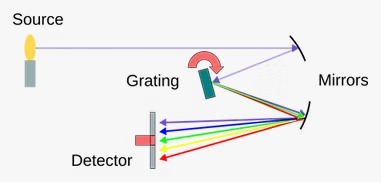
The initial step towards spectroscopy was taken by the man who had an apple fall on
his head, famed English physicist Sir Isaac Newton. In the 1660s, he passed light through a glass prism to be split into a spectrum. This proved that white light was actually a compound color, with each color traveling at a specific wavelength. This foundation was later built in 1814 by German physicist Joseph von Fraunhofer. He had invented the spectroscope to disperse solar light and noticed there were more than 500 dark lines (known as Fraunhofer lines) crossing the spectrum of the Sun. He measured these lines and scientists down the line would experiment with different elements by heating them and comparing it to the recorded dark lines. This would prove the existence of helium in the chromosphere of the Sun in 1868 by French astronomer Pierre Jansson on his visit to India.
Now that spectroscopy has advanced far enough to answer many questions humans have had regarding the chemical composition and properties of many cosmic entities, new intriguing questions have risen. We now ask, what is the origin of life in the universe? How did amino acids and nucleobases come to be? Is there any planet like Earth that can be made of anti-matter? The future holds great potential for seeking answers.